Num8 Double(3/8) zl:0.016 - j0.008℧ z0:100Ω
A lossless 100 coaxial line is terminated by a load of admittance 0.016-j0.008℧. The line is matched by a means of two fixed stubs separated by 3 λ /8 with the first stub placed at the plane of load., Calculated the length of each stub by using Smith Chart.
\[
Y_{NL}=0.016-j0.008\,\mho
\]
\[
\text{i.e.,}
\]
\[
Z_{BL}=\frac{1}{Z_0Y_L}=50+j25
\]
\[
Z_0=100\,\Omega
\]
Step 1: Normalized the load impedance by dividing it by characteristic impedance of line. Plot Zn in the Smith Chart. Construct SWR circle for load line recording the wave length at Yn
Zn= 0.5 + j0.25

SWR = 2.2:1

\[
\text{WTG}_B = 0.301\lambda
\]
\[
Y_B = 1.6 - j0.8
\]
Step 2: Construct the 3/8 Spacing Circle.
The Spacing circle cuts the stub circle at point c and d. Join c and d with the prime circle. Starting at the wavelength reading at the Yn. Move clockwise around the wavelength scale so that the line ends up anywhere between the dashed line C and D. Line C and D describes an arc between two radii that defines the position of SWR Circle reside of spacing circle.

Step 3: Since the Point B (YN) lies between SWR and 3 λ /8 spacing circle. The placement distance of 1st Stub from the load is equal to Point B.
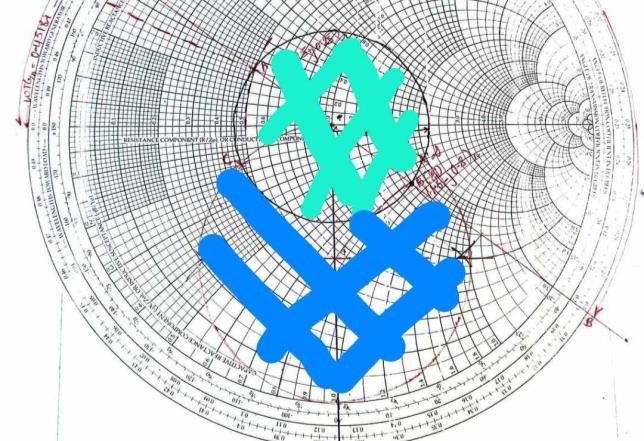
D1 = 0 λ
Step 4: Follow the reactance circle through point B (1.6) in the direction of a smaller reactance. In the case, move left to the point until it meets the spacing circle Move clockwise to the direction of SWR circle until it intersect the spacing circle. Label the point as E.

yE = 1.6 – j0.2
Step 5: Find the difference in reactance between point B and E.
\[
\text{i.e., the amount of susceptance that needs to be cancelled is}
\]
\[
Y_B - Y_E = -j0.8 - \left(-j0.2\right)
\]
\[
= -j0.6
\]
\[
\text{To cancel } -j0.6,\text{ locate the point } +j0.6
\]
\[
\text{and denote it as Point H.}
\]
\[
\text{Measure and record }
\text{WTG}_H.
\]

WTGH = 0.086 λ
Step 6: The Stub length is found in the same way as single stub matching. The length of the 1st Stub is calculated as
\[
\text{For the open-circuited stub, measure clockwise from the zero-admittance point.}
\]
\[
L_{1O} = 0.086\lambda
\]
\[
\text{For the short-circuited stub, measure clockwise from the infinite-admittance point.}
\]
\[
L_{1S} = 0.086\lambda + 0.25\lambda
\]
\[
L_{1S} = 0.336\lambda
\]
Step 7: From Point F, again draw 2nd SWR Circle. Using the point E as a circumference location and prime center of the short as a pivot point. Construct a second SWR circle

SWR2: 1.65:1
Step 9: Extend the line from 2nd SWR circle to clockwise direction till in intersects R=1 circle on inside of the spacing circle, mark that point as H.

\[
Y_H = 1 - j0.5
\]
\[
\text{Find the point } -j0.5 \text{ to cancel } +j0.5
\]
\[
\text{and denote it as Point G.}
\]
\[
\text{WTG}_G = 0.074\lambda
\]
Step 9: The Stub length is found in the same way as single stub matching. The length of the 2nd Stub is calculated as
\[
\text{For the open-circuited stub, measure clockwise from the zero-admittance point.}
\]
\[
L_{2O} = 0.074\lambda
\]
\[
\text{For the short-circuited stub, measure clockwise from the infinite-admittance point.}
\]
\[
L_{2S} = 0.074\lambda + 0.25\lambda
\]
\[
L_{2S} = 0.324\lambda
\]


