Num9 DoublyStub (0.15λ) Zl= 00-j200Ω Zo=100Ω
A double shunt stub matching network is to match a load impedance 100-j200 to a line having characteristic impedance 100 ohm. Assume the distance between the stub as 0.15 λ. Calculate the length of the stub
\[
Z_L = 100 - j200\,\Omega
\]
\[
Z_0 = 100\,\Omega
\]
Step 1: Normalized the load impedance by dividing it by characteristic impedance of line. Plot Zn in the Smith Chart. Construct SWR circle for load line recording the wave length at Yn.
Zn = 1 - j2Ω
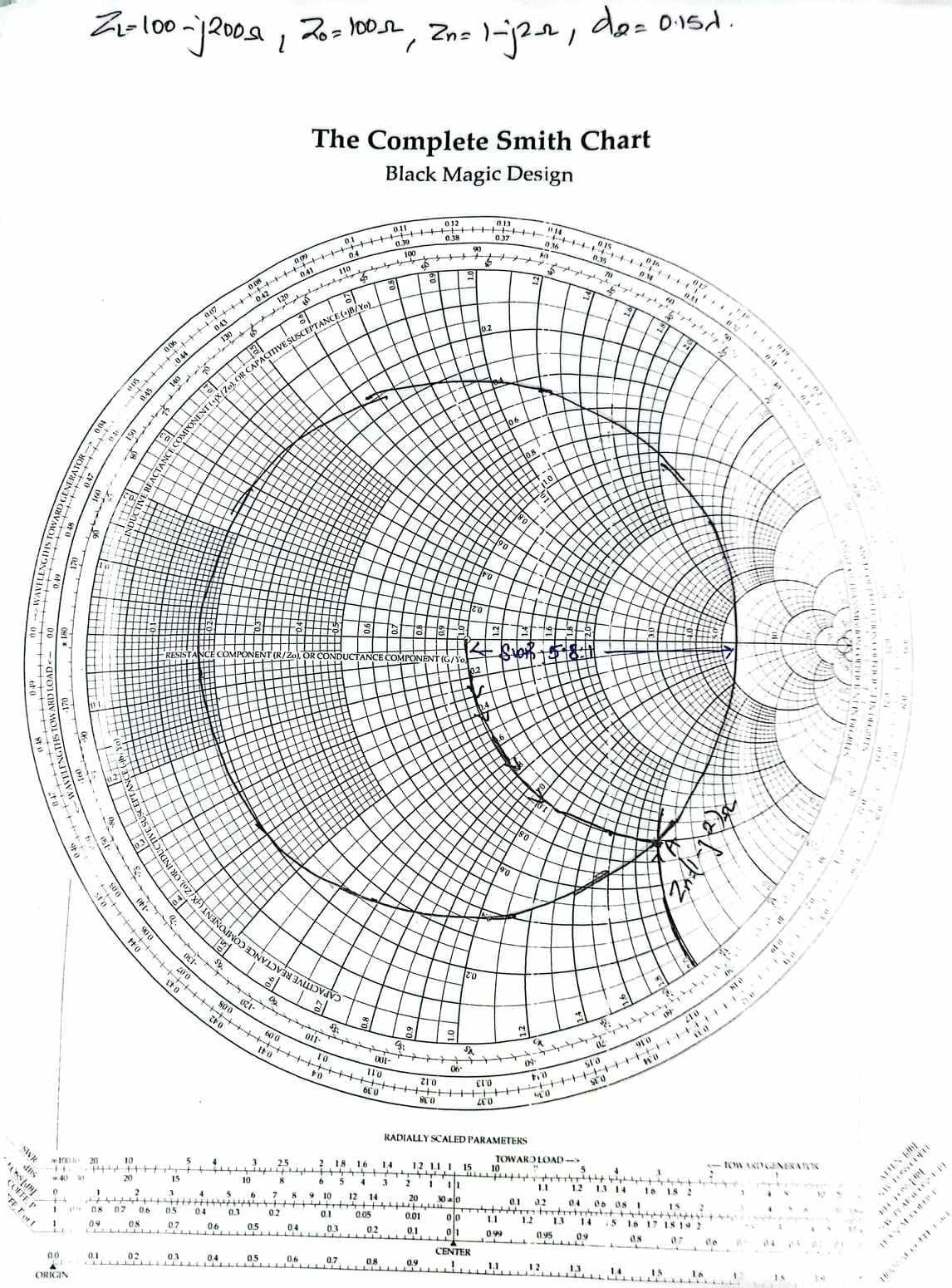
SWR = 5.8:1

\[
Y_N = 0.2 + j0.4
\]
\[
\text{WTG}_B = 0.063\lambda
\]
Step 2: Construct 0.15λ Circle
\[
\text{For the inner circle, the initial distance is } 0.25\lambda.
\]
\[
\text{To move } 0.15\lambda,\text{ the required rotation is}
\]
\[
0.25\lambda + 0.15\lambda = 0.40\lambda
\]
\[
\text{Therefore, rotate } 0.40\lambda \text{ anticlockwise on the inner circle.}
\]
\[
\text{For the outer circle, the initial distance is } 0.25\lambda.
\]
\[
\text{To move } 0.15\lambda,\text{ the required rotation is}
\]
\[
0.25\lambda - 0.15\lambda = 0.10\lambda
\]
\[
\text{Therefore, rotate } 0.10\lambda \text{ anticlockwise on the outer circle.}
\]

Draw 0.15 λ circle

Step 3: Since the distance of 1st stub is not given, we can assume a distance d1 as 0. So point B is equal to point E.
\[
\text{Point E is } 0.2 + j0.4
\]
\[
D_1 = 0\lambda
\]

Solution 1 moving anticlockwise direction
Step 4: Follow the reactance circle through point E (0.73λ) in the direction of a smaller reactance. In the case, move left to the point C at the edge of spacing circle and note the coordinates i.e. move anticlockwise towards the edge of the spacing circle. Label the point as F.

Zf = 0.2+j0.2
Step 5: Find the difference in reactance between point F and E.
\[
\text{i.e., the amount of susceptance that needs to be cancelled is}
\]
\[
X_E - X_F = j0.4 - j0.2
\]
\[
= j0.2
\]
\[
\text{To cancel } j0.2,\text{ locate the point } -j0.2
\]
\[
\text{and denote it as Point G.}
\]
\[
\text{WTG}_G = 0.469\lambda
\]
\[
\text{Step 6: The stub length is found in the same way as single-stub matching.}
\]
\[
\text{The length of the first stub is calculated as follows:}
\]
\[
\text{For the open-circuited stub, measure clockwise from the zero-admittance point.}
\]
\[
L_{1O} = 0.469\lambda
\]
\[
\text{For the short-circuited stub, measure clockwise from the infinite-admittance point.}
\]
\[
L_{1S} = 0.469\lambda - 0.25\lambda
\]
\[
L_{1S} = 0.219\lambda
\]
Step 7: From Point F, again draw 2nd SWR Circle. Using the point F as a circumference location and prime center of the short as a pivot point. Construct a second SWR circle
SWR2 = 7:1
Step 8: From point F, move around the 2nd SWR circle in clockwise direction until reaching to R=1 circle on the inside of the spacing circle, note the edge as H.

ZH = 1+j1.9
Step 9: Find the point j1.9 to cancel -j1.9 and note it as Point I
\[
\text{Now draw a line to that point.}
\]
\[
\text{WTG}_I = 0.328\lambda
\]
Step 10: The stub length is found in the same way as single-stub matching.
\[
\text{The length of the second stub is calculated as follows:}
\]
\[
\text{For the open-circuited stub, measure clockwise from the zero-admittance point.}
\]
\[
L_{2O} = 0.328\lambda
\]
\[
\text{For the short-circuited stub, measure clockwise from the infinite-admittance point.}
\]
\[
L_{2S} = 0.328\lambda - 0.25\lambda
\]
\[
L_{2S} = 0.078\lambda
\]

Solution 2 moving clockwise direction
Step 4: Follow the reactance circle through point E (0.73λ) in the direction of a smaller reactance. In the case, move left to the point C at the edge of spacing circle and note the coordinates i.e. move clockwise towards the edge of the spacing circle. Label the point as F.

Zf = 0.2-j1.3
Step 5: Find the difference in reactance between point F and E.
\[
\text{i.e., the amount of susceptance that needs to be cancelled is}
\]
\[
X_E - X_F = j0.2 - j1.1
\]
\[
= -j0.9
\]
\[
\text{To cancel } j0.9,\text{ locate the point } -j0.9
\]
\[
\text{and denote it as Point G.}
\]
\[
\text{WTG}_G = 0.384\lambda
\]
\[
\text{Step 6: The stub length is found in the same way as single-stub matching.}
\]
\[
\text{The length of the first stub is calculated as follows:}
\]
\[
\text{For the open-circuited stub, measure clockwise from the zero-admittance point.}
\]
\[
L_{1O} = 0.384\lambda
\]
\[
\text{For the short-circuited stub, measure clockwise from the infinite-admittance point.}
\]
\[
L_{1S} = 0.384\lambda - 0.25\lambda
\]
\[
L_{1S} = 0.134\lambda
\]
Step 7: From Point F, again draw 2nd SWR Circle. Using the point F as a circumference location and prime center of the short as a pivot point. Construct a second SWR circle
 SWR2 = 20:1
Step 8: From point F, move around the 2nd SWR circle in clockwise direction until reaching to R=1 circle on the inside of the spacing circle, note the edge as H.
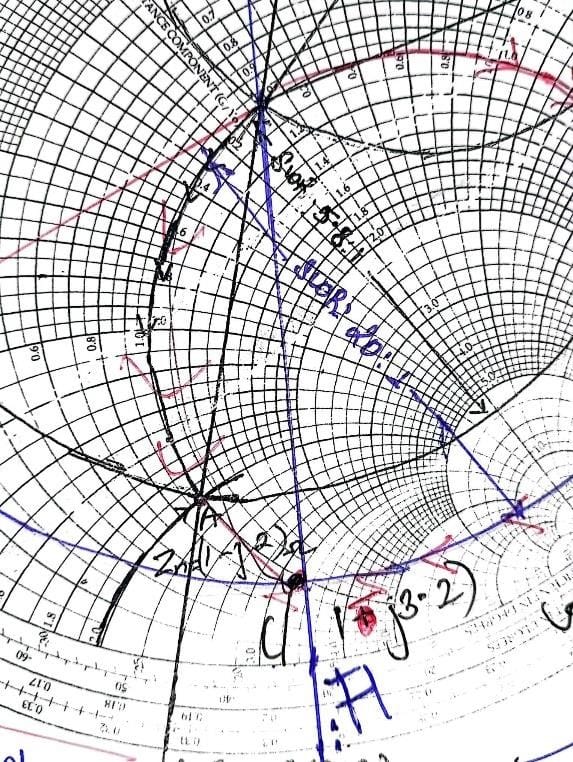
ZH = 1-j3.2
Step 9: Find the point -j3.2 to cancel +j3.2 and note it as Point I
Now draw a line to that point

WTGI = 0.22 λ
Step 10: The Stub length is found in the same way as single stub matching. The length of the 2nd Stub is calculated as
\[
\text{For the open-circuited stub, measure clockwise from the zero-admittance point.}
\]
\[
L_{2O} = 0.22\lambda
\]
\[
\text{For the short-circuited stub, measure clockwise from the infinite-admittance point.}
\]
\[
L_{2S} = 0.22\lambda + 0.25\lambda
\]
\[
L_{2S} = 0.47\lambda
\]