Waveguide as Transmission line
Microwave systems operate at extremely high frequencies where ordinary transmission lines begin to struggle. As frequency increases, conductor losses, radiation losses, and dielectric losses become more significant. This is why microwave engineers often replace conventional cables with waveguides for efficient power transmission at microwave frequencies.
Microwave Device Types
Microwave devices are generally classified into two categories: passive devices and active devices. Passive microwave devices do not require an external power source for operation. They simply guide, divide, combine, or control electromagnetic energy. Common examples include transmission lines, probes, directional couplers, tees, and isolators.
Active microwave devices require external energy to operate. These devices can amplify, generate, or control microwave signals. Examples include traveling wave tubes (TWTs), microwave generators, and power amplifiers. Unlike passive components, active devices can provide gain and increase signal power.
Why Conventional Transmission Lines Become Inefficient
At frequencies around 1 GHz and above, the ability of ordinary cables to transport electromagnetic energy begins to decrease. The skin effect forces current to flow only on the outer surface of conductors, increasing effective resistance and causing greater power loss.
As frequency rises further, radiation losses become more noticeable. Even when a transmission line is perfectly matched to its load, a portion of the transmitted energy may never reach the destination because it is dissipated as heat or radiated into the surrounding environment.
Above approximately 20 GHz, coaxial cables become impractical for many applications, especially over longer distances. Another limitation is voltage breakdown. High-power microwave signals can exceed the dielectric strength of the insulating material between conductors, leading to insulation failure and system damage.
What Is a Microwave Waveguide?
A microwave waveguide is a hollow conducting structure designed to guide electromagnetic waves from one location to another. Unlike conventional transmission lines, a waveguide does not transport energy through current flow in conductors. Instead, it provides a controlled path that confines electromagnetic fields within a metallic enclosure.
The conducting walls act as boundaries that direct the propagation of electric and magnetic fields. Because the structure is completely enclosed, electromagnetic energy remains confined inside the waveguide and cannot easily radiate outward.
This design dramatically reduces radiation losses. Only a small amount of power is lost due to heating in the metallic walls, making waveguides highly efficient for microwave-frequency applications.
Types of Microwave Waveguides

Rectangular Waveguide
The rectangular waveguide is the most widely used waveguide in microwave engineering. Its geometry supports efficient propagation of microwave signals while maintaining a relatively compact size. For a given wavelength, a rectangular waveguide is typically smaller than a circular waveguide, making it easier to manufacture and integrate into practical systems.
Circular Waveguide
A circular waveguide uses a cylindrical conducting structure. It can handle high power levels and supports multiple propagation modes. Although useful in specialized applications, circular waveguides are generally less common than rectangular waveguides because mode control is often more challenging.
Waveguide Modes of Propagation

Electromagnetic waves propagate inside waveguides in specific field configurations known as modes. The two most important waveguide modes are Transverse Electric (TE) mode and Transverse Magnetic (TM) mode.
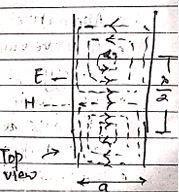
TE Mode (Transverse Electric Mode)
In TE mode, the electric field component in the direction of propagation is zero. In other words, the electric field has no longitudinal component along the waveguide axis. Energy propagation occurs through the transverse field components.
TE modes are the most commonly used modes in rectangular waveguides. The dominant mode for rectangular waveguides is TE10, which offers efficient transmission with relatively low attenuation.
TM Mode (Transverse Magnetic Mode)
In TM mode, the magnetic field component along the direction of propagation is zero. The electromagnetic energy is carried by the remaining transverse electric and magnetic field components.
TM modes are important in many theoretical and practical microwave applications, although they are often less commonly used than dominant TE modes.
Cutoff Frequency in Waveguides
One of the most important characteristics of a microwave waveguide is its cutoff frequency. A waveguide behaves much like a high-pass filter.
Below the cutoff frequency, electromagnetic waves cannot propagate through the structure. Any signal applied below this threshold experiences rapid attenuation and effectively dies out before reaching the output.
Once the operating frequency exceeds the cutoff frequency, propagation becomes possible. The signal travels through the waveguide with relatively low loss. As frequency continues to increase, attenuation generally rises gradually.
At higher frequencies, additional propagation modes may become active. These higher-order modes can carry energy, but they often produce more complex field patterns and may complicate system design.
Advantages of Waveguides
Waveguides offer several advantages over conventional transmission lines at microwave frequencies. They exhibit extremely low radiation loss, support high power transmission, provide excellent shielding, and eliminate many of the limitations associated with coaxial cables at very high frequencies.
Because electromagnetic fields remain confined within the conducting enclosure, waveguides are widely used in radar systems, satellite communication, microwave links, particle accelerators, and high-frequency measurement equipment.
Key Exam Takeaway
For microwave engineering exams, remember these points:
- Waveguides are preferred over coaxial cables at very high frequencies.
- Waveguides guide electromagnetic fields rather than carrying current like ordinary wires.
- Rectangular and circular waveguides are the two primary types.
- TE mode has no electric field component along the direction of propagation.
- TM mode has no magnetic field component along the direction of propagation.
- Waveguides behave as high-pass structures and have a cutoff frequency.
- Below cutoff frequency, propagation does not occur.
- The dominant mode in rectangular waveguides is TE10.