Waveguide Slot/Apperature Coupling
Waveguide Slot Coupling
Waveguide slot coupling is a method of transferring microwave energy into or out of a waveguide through a small opening, commonly called a slot or aperture. This technique is particularly useful when very loose coupling is required and only a small amount of microwave energy needs to pass between two regions. Unlike a large coupling structure that transfers a significant portion of the available power, a small aperture allows only a limited amount of electromagnetic energy to enter the waveguide. The slot therefore acts as a controlled electromagnetic coupling mechanism. Its dimensions, shape, position, and orientation determine the amount of energy transferred and have a direct influence on the reflection and impedance characteristics of the coupling structure.
Principle of Slot Coupling

The basic principle of waveguide slot coupling is based on the interaction of the electromagnetic field with a small opening in the conducting wall of the waveguide. When microwave energy is applied to one side of the slot, the electric field extends through the aperture and begins to establish an electromagnetic field inside the waveguide. The electric field lines initially pass across the small opening and then spread into the interior region of the guide. In this way, the slot provides a controlled path through which electromagnetic energy can be transferred without requiring a direct metallic connection between the two regions. The size of the aperture is deliberately kept small when weak coupling is required, allowing only a relatively small portion of the incident microwave energy to enter the waveguide.
Electric Field Expansion Through the Slot
When microwave energy reaches the aperture, the electric field does not remain confined to the immediate region of the slot. The E field passes across the opening and expands into the interior of the waveguide. The field distribution inside the guide is then determined by the geometry of the waveguide and the propagation mode that is excited. The electric field lines first cross the slot and subsequently spread throughout the available space inside the waveguide. If the aperture is correctly designed, the resulting field distribution couples effectively to the desired waveguide mode. The shape and dimensions of the slot therefore play an important role in controlling how the electromagnetic field enters the guide and how efficiently the required mode is excited.
Loose Coupling Using a Small Aperture
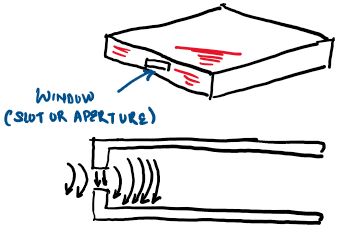
A small slot is generally used when very loose or weak coupling is required. Since the opening is small compared with the wavelength and the waveguide dimensions, only a small amount of electromagnetic energy can pass through the aperture. This makes slot coupling useful when the objective is to sample a microwave signal or transfer a limited amount of power without significantly disturbing the main electromagnetic field inside the waveguide. Increasing the size of the aperture generally increases the amount of energy that can pass through it, while reducing the aperture size produces weaker coupling. The slot dimensions can therefore be selected according to the required coupling level and the operating frequency of the microwave system.
Effect of Slot Dimensions
The dimensions of the slot must be carefully selected because the aperture determines the electromagnetic coupling between the two regions. A slot that is too small may provide extremely weak coupling, making the transferred signal difficult to detect or use. On the other hand, an excessively large aperture can allow too much microwave energy to pass through and may disturb the field distribution of the waveguide. The length, width, shape, and orientation of the slot all influence the coupling characteristics. These parameters must be selected in relation to the operating wavelength and the required power transfer so that the aperture provides the desired coupling without producing excessive reflections or unwanted field disturbances.
Frequency and Slot Coupling
The operating frequency is an important consideration in the design of a waveguide slot coupler because the electrical size of the aperture changes with wavelength. A slot having fixed physical dimensions can behave differently at different frequencies because its dimensions represent different fractions of the electromagnetic wavelength. For efficient and controlled coupling, the slot dimensions must therefore be selected according to the frequency at which the system is intended to operate. When the aperture is properly proportioned to the wavelength, the electromagnetic field can pass through the slot with controlled coupling and reduced reflection. This frequency dependence is particularly important in microwave systems because even relatively small changes in physical dimensions can produce noticeable changes in electrical performance.
Minimizing Reflections in Slot Coupling
Reflections occur when the electromagnetic energy encounters an impedance discontinuity at the coupling aperture. If the slot dimensions are not properly selected, part of the incident energy can be reflected back toward the source instead of entering the waveguide. Properly proportioning the size and shape of the aperture to the operating frequency helps control the impedance presented by the coupling structure and reduces unwanted reflections. The objective is to allow the required amount of microwave energy to enter or leave the waveguide while maintaining a suitable electromagnetic transition at the slot. Proper aperture design therefore improves energy transfer and helps maintain stable operation of the waveguide system.
Energy Injection Through a Slot
When a slot is used to introduce microwave energy into a waveguide, the electromagnetic field reaches the aperture from the external region and passes through the opening. The E field initially crosses the slot and then expands into the interior of the waveguide. As the field develops inside the guide, it interacts with the boundary conditions imposed by the conducting walls and establishes the field distribution associated with a supported propagation mode. If the operating frequency is above the cutoff frequency of that mode, the coupled electromagnetic energy can propagate along the waveguide. The amount of injected power depends on the aperture dimensions, field strength at the slot, frequency, and relative orientation of the slot with respect to the electromagnetic field.
Energy Extraction Through a Slot
The same aperture can also be used in the reverse direction to remove microwave energy from a waveguide. When electromagnetic energy is already propagating inside the guide, a portion of its electric field interacts with the slot and extends through the aperture into the external region. The transferred field can then be collected by another transmission structure or microwave circuit. Since the aperture is small, only a limited fraction of the total waveguide power is normally extracted when loose coupling is required. This allows a microwave signal to be sampled without significantly changing the main power flow inside the guide. The same slot therefore provides a controlled mechanism for both introducing and removing electromagnetic energy.
Relationship Between Slot Size and Coupling
The size of the aperture has a direct relationship with the strength of electromagnetic coupling. A smaller slot generally permits less energy to pass through and therefore produces weaker coupling, while increasing the effective aperture area allows a greater amount of electromagnetic energy to interact across the opening. The relationship is not determined by physical size alone because the slot dimensions must also be considered relative to the operating wavelength and the field distribution at its location. A properly designed aperture provides the required coupling level while maintaining acceptable reflection characteristics. For this reason, slot dimensions are normally optimized according to the frequency, waveguide geometry, desired coupling coefficient, and power level of the microwave system.