Waveguides
Waveguide: Definition, Characteristics, Types, Applications and Advantages
A waveguide is a physical transmission medium through which electromagnetic waves are guided from one point to another. Unlike conventional electrical transmission lines that carry signals using conductors, a waveguide guides electromagnetic energy through a hollow metallic structure or a dielectric medium. Waveguides are particularly important at microwave and higher frequencies, where they can provide efficient transmission with relatively low loss and excellent shielding from external interference. The most common metallic waveguides have rectangular or circular cross-sections. Inside the guide, the electromagnetic fields are confined by the structure and propagate in specific patterns called modes. Thus, a waveguide provides a controlled path for electromagnetic energy, especially in high-frequency and high-power microwave systems.
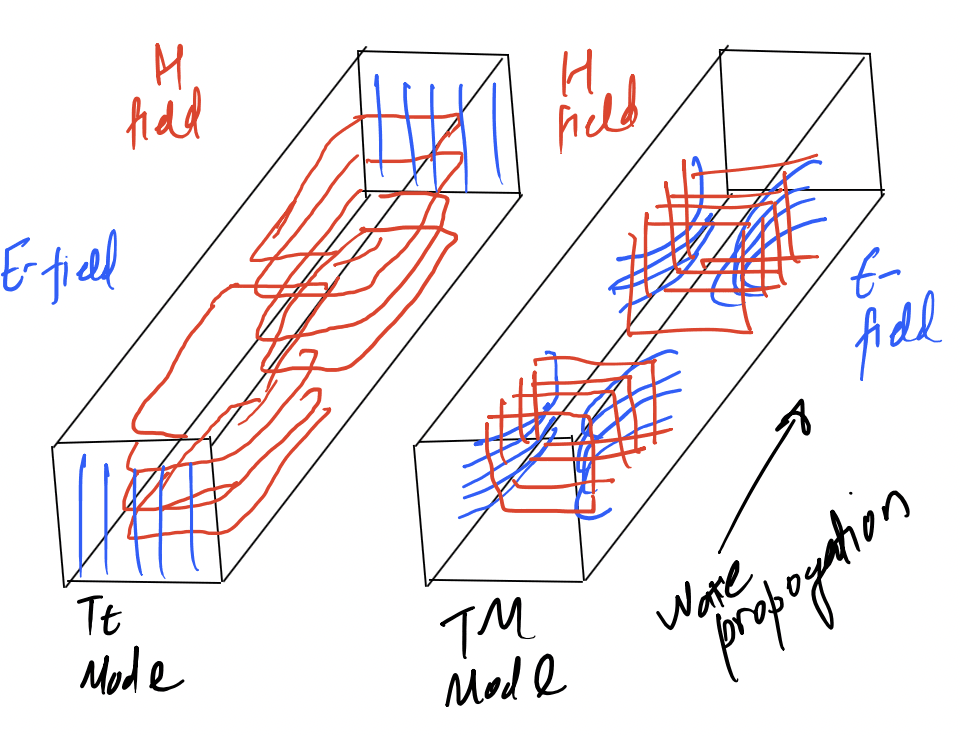
Fig: Rectangular Waveguide
Key Characteristics of Waveguides
Waveguides have several characteristics that distinguish them from conventional transmission lines. Their ability to guide electromagnetic energy at microwave frequencies, confine the fields within the structure, support specific propagation modes, and handle significant amounts of power makes them particularly useful in radar, satellite communication, antenna feed systems, and other microwave applications.
1. Frequency Range
Waveguides are primarily used for high-frequency electromagnetic signal transmission, particularly in the microwave frequency range. They are commonly employed above approximately 1 GHz, with suitable waveguide structures also being used at millimeter-wave and even higher frequencies. The operating frequency range of a waveguide depends strongly on its physical dimensions and propagation characteristics. Because the dimensions of the guide are related to the wavelength of the electromagnetic signal, a waveguide must be appropriately designed for the frequency range in which it is intended to operate.
2. No Signal Radiation
A major characteristic of a waveguide is its ability to confine electromagnetic energy within the guiding structure. Unlike open-wire transmission lines, where electromagnetic fields can extend significantly into the surrounding space, a properly designed metallic waveguide provides strong confinement of the fields. This reduces unwanted radiation and helps protect the transmitted signal from external electromagnetic interference. The shielding provided by the waveguide is particularly valuable in microwave systems where maintaining signal integrity is important.
3. Low Loss
Waveguides can provide relatively low transmission loss at microwave frequencies, particularly when designed and operated within their intended frequency range. In a hollow metallic waveguide, there is no center conductor carrying the signal in the same way as a conventional coaxial cable. Instead, electromagnetic fields propagate through the interior of the guide while the conducting walls support the required field distribution. Although conductor and dielectric losses still exist, properly designed waveguides can provide efficient transmission of microwave energy, especially over short and moderate distances.
4. Directional Control
Waveguides provide controlled propagation of electromagnetic energy through specific field configurations known as modes. The physical dimensions and shape of the waveguide determine which modes can propagate at a particular frequency. This controlled mode propagation helps guide microwave energy in a predictable direction and makes waveguides useful for maintaining signal integrity in high-frequency systems. Proper mode selection and operation are important because unwanted modes can affect the performance of the microwave system.
5. Rigid Construction
Most conventional microwave waveguides are constructed from rigid conductive materials such as copper or aluminum. Their rigid structure provides mechanical stability and helps maintain the precise dimensions required for reliable electromagnetic propagation. However, this construction also makes waveguides less flexible than conventional cables. Bends, joints, and connections must be designed carefully because changes in geometry can affect the propagation characteristics and introduce unwanted reflections or losses.
Types of Waveguides
Waveguides can be classified in different ways depending on their physical shape, construction material, and mode of electromagnetic wave propagation. Based on these characteristics, common classifications include rectangular and circular waveguides based on shape, metallic and dielectric waveguides based on material, and single-mode and multimode waveguides based on propagation mode.
1. Based on Shape
Rectangular Waveguide
A rectangular waveguide has a hollow rectangular cross-section and is one of the most widely used waveguide structures in microwave engineering. Its dimensions are selected according to the desired operating frequency and propagation characteristics. Rectangular waveguides can support different electromagnetic modes, with the dominant mode commonly used for practical microwave transmission. They are widely employed in radar systems, satellite communication equipment, microwave measurement systems, laboratory equipment, and antenna feed networks because of their well-defined propagation characteristics and convenient integration with other microwave components.
Circular Waveguide
A circular waveguide has a hollow circular cross-section and supports electromagnetic propagation through modes determined by its diameter and operating frequency. Its circular geometry provides characteristics that can be useful in applications requiring rotational symmetry or specialized mechanical arrangements. Circular waveguides can support multiple modes, and their properties make them suitable for certain high-power microwave systems, antenna feed structures, and rotating-joint applications where the geometry of a rectangular guide may be less convenient.
2. Based on Material
Metallic Waveguides
Metallic waveguides are constructed from conductive materials such as copper, aluminum, or other suitable metals. These are the conventional waveguides widely used in microwave and radar systems. The electromagnetic fields propagate through the interior of the guide while the conducting walls provide the boundary required to confine and guide the energy. Metallic waveguides offer good shielding, high power-handling capability, and efficient microwave transmission, making them particularly useful in high-frequency systems where conventional cables may become less suitable.
Dielectric Waveguides
Dielectric waveguides use dielectric materials rather than hollow metallic walls to guide electromagnetic energy. Optical fibers are an important example of dielectric waveguides because they guide light through a dielectric core surrounded by a suitable cladding material. Unlike conventional metallic microwave waveguides, optical dielectric waveguides are primarily associated with the propagation of optical-frequency electromagnetic waves. They are widely used in optical communication systems in which light generated by sources such as LEDs or laser diodes is guided through the fiber.
3. Based on Mode of Propagation
Single-Mode Waveguide
A single-mode waveguide is designed or operated so that only one propagation mode is supported within the intended operating range. Restricting propagation to a single mode helps avoid interference between different propagation modes and provides a well-defined electromagnetic field distribution. Single-mode operation is therefore useful in applications where accurate signal transmission, controlled propagation, and reduced modal effects are important.
Multimode Waveguide
A multimode waveguide allows multiple propagation modes to exist at the same time. Different modes have different field distributions and propagation characteristics, so their simultaneous presence can make the electromagnetic behavior of the system more complex. Multimode operation can be useful in applications where multiple modes are intentionally supported, but unwanted modal interactions can also affect signal quality. Therefore, careful design and mode control are important when using multimode waveguide structures.
Applications of Waveguides
Waveguides are widely used in systems that require efficient transmission of high-frequency electromagnetic energy, particularly where low loss, high power handling, and strong electromagnetic shielding are important. Their applications range from radar and satellite communication to microwave heating, antenna feeds, specialized telecommunications, and certain medical systems.
Radar Systems
Waveguides are an important component of radar transmitter and receiver systems. They are used to guide high-frequency electromagnetic energy between microwave sources, receivers, and radar antennas. Their low-loss characteristics and ability to handle significant microwave power make them suitable for transmitting radar signals while maintaining efficient energy transfer between the different components of the system.
Satellite Communication
Waveguides are used in satellite communication equipment and ground stations to connect microwave transmitters, receivers, and antennas. Satellite communication systems operate at high frequencies where waveguides can provide efficient transmission and good electromagnetic shielding. Their ability to guide microwave energy with relatively low loss makes them useful in antenna feed networks and other high-frequency sections of satellite communication systems.
Microwave Ovens
In a microwave oven, a waveguide is used to transfer microwave energy generated by the magnetron toward the cooking chamber. The waveguide provides a controlled path for the microwave energy between the source and the chamber. The geometry and position of the waveguide help deliver the microwave energy into the cooking compartment, where the electromagnetic energy interacts with the food and produces heating.
Telecommunication Systems
Although optical fiber and coaxial cable are widely used for modern long-distance communication, waveguides remain important in specialized RF and microwave telecommunication systems. They can be used in high-frequency links, microwave backhaul equipment, military communication systems, and space communication systems where efficient transmission of microwave energy and strong shielding are required.
Medical Equipment
Waveguides are also used in certain medical and laboratory systems that require controlled delivery of electromagnetic energy. Specialized high-frequency equipment can use waveguide structures to guide electromagnetic energy toward a specific location or component. Their controlled propagation characteristics make them useful wherever electromagnetic energy must be transferred efficiently and accurately within specialized equipment.
Antenna Feed Systems
Antenna feed systems are one of the important applications of waveguides in microwave engineering. Waveguides can connect microwave sources, receivers, and transmission components to antennas such as horn antennas and parabolic reflector antennas. They provide an efficient path for transferring high-frequency electromagnetic energy between the microwave equipment and the antenna, particularly at frequencies where conventional cables may introduce greater loss or become less practical.
Advantages of Waveguides
Waveguides offer several important advantages for the transmission of electromagnetic energy, particularly at microwave and higher frequencies. Their enclosed structure, controlled propagation characteristics, high power-handling capability, and relatively low transmission loss make them suitable for radar, satellite communication, microwave heating, antenna feed systems, and other high-frequency applications. The major advantages of waveguides are described below.
1. High-Frequency Operation
Waveguides are particularly suitable for high-frequency electromagnetic signal transmission. At microwave frequencies, conventional transmission lines such as ordinary wires may experience increased losses and other limitations as the frequency becomes higher. Waveguides are designed so that their physical dimensions are related to the wavelength of the electromagnetic signal, allowing microwave energy to propagate efficiently through the guide in specific modes. They are therefore widely used for microwave, millimeter-wave, and other high-frequency applications where efficient guided-wave transmission is required.
2. Low Transmission Loss
Waveguides can provide relatively low transmission loss within their designed operating frequency range. In a hollow metallic waveguide, electromagnetic energy propagates through the interior of the structure rather than being carried by a central conductor as in a coaxial cable. Although some power is lost due to finite conductivity of the waveguide walls and other practical effects, the losses can be relatively small at suitable microwave frequencies. This allows waveguides to transfer high-frequency electromagnetic energy efficiently, particularly over short and moderate transmission distances.
3. Excellent Shielding
The enclosed construction of a waveguide provides excellent shielding against external electromagnetic interference. Since the electromagnetic fields are largely confined within the waveguide, the transmitted energy is protected from many external sources of electromagnetic noise. At the same time, the enclosed structure helps minimize unwanted radiation from the transmission path. This characteristic is especially useful in sensitive microwave systems, radar equipment, communication systems, and laboratory environments where unwanted electromagnetic coupling can affect system performance.
4. High Power Handling Capability
Waveguides can handle relatively high levels of microwave power. Their structure allows electromagnetic energy to propagate through the guide without requiring a small central conductor to carry the signal current in the same manner as a conventional coaxial cable. Properly designed waveguides can therefore be used to transfer substantial amounts of microwave power while maintaining efficient operation. This makes them particularly useful in high-power radar transmitters, microwave communication equipment, satellite systems, microwave heating equipment, and other applications where significant electromagnetic power must be transferred from one component to another.
5. Efficient Microwave Transmission
Waveguides provide efficient and controlled transmission of microwave energy. The physical dimensions and shape of the guide determine the modes that can propagate, allowing the electromagnetic field to be guided in a predictable manner. This controlled propagation is particularly useful for connecting microwave sources, receivers, and antennas. Waveguides are therefore widely used in antenna feed systems, radar systems, satellite communication equipment, and other microwave applications where efficient transfer of electromagnetic energy is required.
Limitations of Waveguides
Although waveguides provide excellent performance at microwave frequencies, they also have several limitations when compared with conventional transmission lines and cables. Their rigid construction, frequency-dependent operation, installation requirements, and relatively high cost can make them unsuitable for general-purpose signal transmission. The major limitations of waveguides are described below.
1. Limited Flexibility
Conventional waveguides are generally rigid and less flexible than cables. Metallic waveguides are manufactured with precise physical dimensions that must be maintained for proper electromagnetic propagation. As a result, they cannot normally be twisted, stretched, or bent freely like flexible electrical cables. Sharp bends or changes in the waveguide geometry can disturb the electromagnetic field distribution and introduce additional reflections or losses. This makes the physical installation of waveguides more difficult, particularly when the transmission path contains many bends or limited available space.
2. Precise Installation and Alignment Required
Waveguides require accurate installation, alignment, and connection. Since the electromagnetic behavior of a waveguide depends strongly on its dimensions and geometry, the joints between different waveguide sections must be properly aligned. Incorrectly fitted flanges, poorly designed bends, gaps, or mechanical discontinuities can cause impedance mismatches and unwanted reflections. These effects can reduce the amount of power delivered to the load and affect the overall performance of the microwave system. Therefore, waveguide installation requires greater mechanical precision than many conventional cable-based transmission systems.
3. Higher Cost
Waveguide systems can be more expensive than conventional transmission lines. The manufacturing process requires accurate control of the waveguide dimensions, surface quality, and mechanical construction. In addition to the waveguide itself, a complete system may require specialized flanges, bends, twists, transitions, couplers, adapters, and other microwave components. The installation and alignment of these components can also increase the overall system cost. For this reason, waveguides are generally selected when their high-frequency performance, low loss, shielding, or power-handling advantages justify the additional cost.
4. Limited Frequency Range
A particular waveguide is designed to operate effectively over a specific frequency range. The dimensions of the waveguide determine its cutoff frequencies and the propagation modes that can exist inside it. If the operating frequency is below the required cutoff frequency, the desired mode cannot propagate through the guide effectively. At frequencies much higher than the intended operating range, additional modes may become possible, which can complicate signal propagation and affect system performance. Therefore, the dimensions of a waveguide must be selected carefully according to the required operating frequency range.
5. Specialized Applications
Waveguides are mainly used in specialized high-frequency systems rather than general-purpose electrical wiring. Their rigid construction, frequency-dependent operation, installation requirements, and relatively high cost make them impractical for ordinary low-frequency electrical connections. They are instead commonly found in microwave and millimeter-wave systems such as radar, satellite communication, antenna feed networks, microwave instruments, and high-frequency industrial equipment. For lower-frequency and general communication applications, conventional transmission lines such as twisted pair, coaxial cable, and optical fiber are often more practical depending on the application.
Therefore, the selection of a waveguide depends on the requirements of the particular system. Its major strengths are high-frequency operation, low transmission loss, excellent electromagnetic shielding, high power-handling capability, and efficient microwave transmission. However, these advantages must be considered along with its limited flexibility, precise installation requirements, higher cost, frequency-dependent operation, and specialized applications.