Evolution of Internet
2070 Magh (Back): Write down the history of Internet. Explain how is it developed to this stage
1961–1972: Early Packet Switching (Foundation of the Internet)
The origins of the Internet can be traced to research in the early 1960s on more efficient and reliable communication systems. In 1961, Leonard Kleinrock demonstrated through queueing theory that breaking data into small packets and transmitting them across a shared network would improve efficiency compared to traditional circuit-switched systems. His work provided the mathematical foundation for packet switching.
In 1964, Paul Baran at the RAND Corporation proposed a distributed communication network for military use. His design suggested dividing messages into smaller blocks that could travel independently across multiple routes. This structure would allow the network to continue functioning even if parts of it were destroyed, making it highly resilient.
In 1967, the Advanced Research Projects Agency (ARPA) conceived ARPAnet as a research network to connect universities and research institutions. In 1969, the first ARPAnet node became operational at UCLA. Soon after, additional nodes were established at Stanford Research Institute, UC Santa Barbara, and the University of Utah. This marked the first successful implementation of packet-switching technology.
By 1972, ARPAnet had grown to dozens of nodes and was publicly demonstrated. During this period, the Network Control Protocol (NCP) was introduced as the first host-to-host communication protocol, enabling standardized communication between connected computers. Electronic mail also emerged as a major application, quickly becoming one of the network’s most popular services.
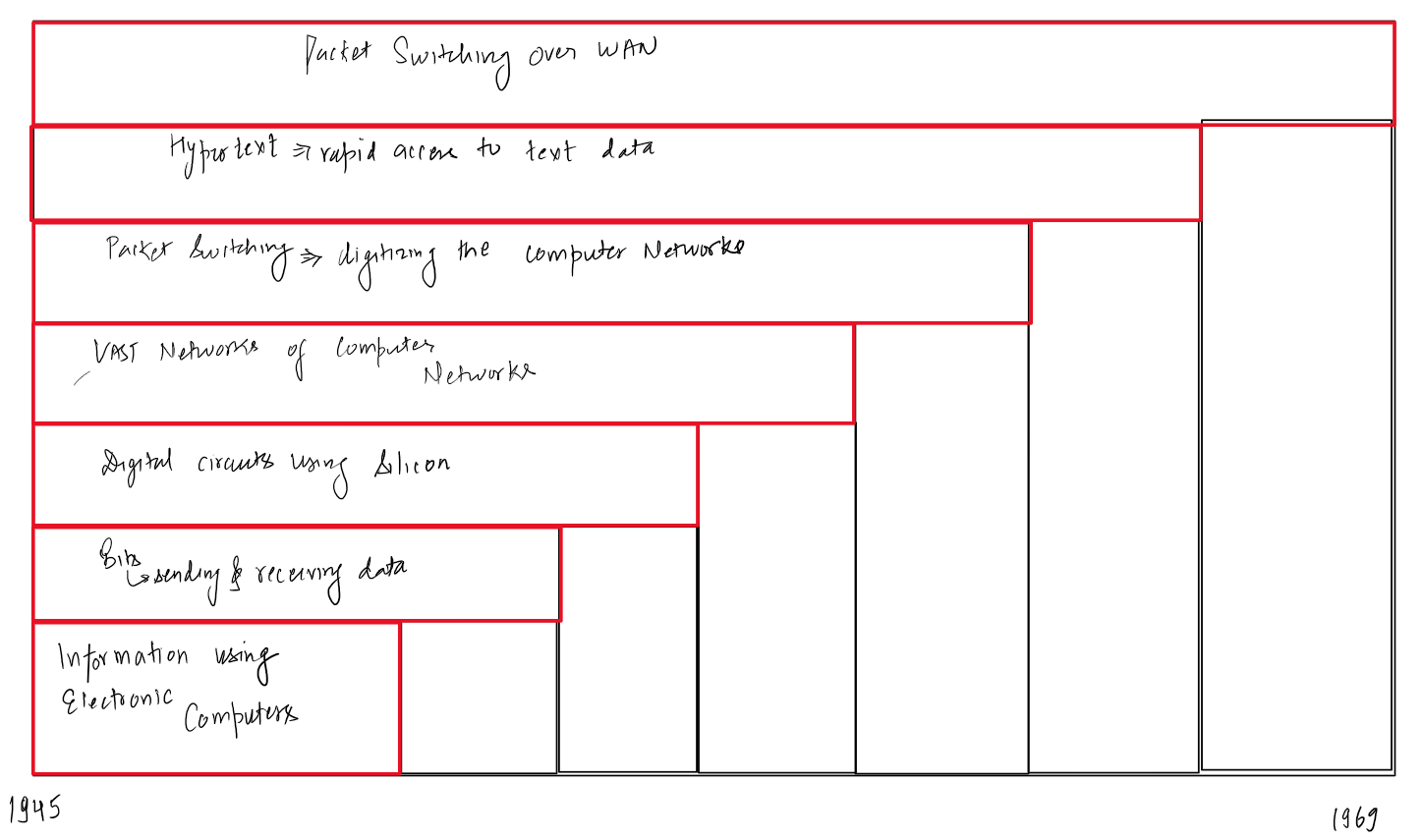
Fig: Evolution from 1945 to 1969
1972–1980s: Internetworking and Proprietary Networks
After 1972, research shifted from building a single packet-switched network to interconnecting multiple networks. In 1974, Vinton Cerf and Robert Kahn proposed the Transmission Control Protocol (TCP), which introduced the concept of internetworking—connecting different networks into a single, unified system. This architecture allowed networks with different designs to communicate with each other.
During the 1970s, several important networking technologies emerged. In 1970, ALOHAnet was developed in Hawaii as a packet-based radio network. In 1976, Ethernet was created at Xerox PARC, providing a method for connecting computers within local area networks (LANs). These innovations expanded networking beyond large research institutions.
At the same time, many organizations developed proprietary networking systems. Examples included DECnet by Digital Equipment Corporation, Systems Network Architecture (SNA) by IBM, and XNA. These systems were often incompatible with one another. Research also continued into technologies such as Asynchronous Transfer Mode (ATM), which used fixed-length packets for high-speed communication.
During this period, ARPAnet continued to expand. By the late 1970s, it had grown significantly, demonstrating the practical value of packet-switched communication.

Fig: Evolution from 1970 to 1999
1980s to 1990s: The First “Internet” (IBM and MCI Partnership)
The 1980s marked the transition from experimental networks to what could be recognized as the early Internet. In 1983, TCP/IP replaced NCP as the standard communication protocol on ARPAnet. This transition is considered a major milestone because it allowed multiple independent networks to interconnect seamlessly.
Several core Internet protocols were developed during this decade. In 1982, the Simple Mail Transfer Protocol (SMTP) was defined for sending email. In 1983, the Domain Name System (DNS) was introduced to translate human-readable domain names into numerical IP addresses. In 1985, the File Transfer Protocol (FTP) was standardized to enable file sharing between computers. In 1988, TCP congestion control mechanisms were introduced to improve network stability and performance.
New national and international networks emerged, including CSNET, BITNET, NSFNET, and Minitel. NSFNET, funded by the National Science Foundation, became the major backbone network in the United States after ARPAnet was gradually phased out in the early 1990s. By the late 1980s, approximately 100,000 hosts were connected across a growing confederation of networks.
During this time, commercial telecommunications companies such as IBM and MCI played an increasing role in expanding network infrastructure. High-speed lines such as T1 (1.5 Mbps) were deployed, and backbone networks were upgraded with improved routers and switches. These developments laid the groundwork for large-scale public networking.
1990 to 2000s: Commercialization of the Web
The 1990s marked the transformation of the Internet from a research and academic network into a global commercial system. In the early 1990s, ARPAnet was officially decommissioned. In 1991, the National Science Foundation lifted restrictions on the commercial use of NSFNET, and by 1995, NSFNET itself was decommissioned, allowing private companies to operate Internet backbone services.
A major breakthrough occurred with the development of the World Wide Web. Hypertext Markup Language (HTML) and the Hypertext Transfer Protocol (HTTP) enabled users to access and navigate information easily through web browsers. The introduction of graphical web browsers in the mid-1990s made the Internet accessible to the general public.
By the late 1990s, Internet usage grew rapidly. Commercial websites, online services, and e-commerce platforms expanded worldwide. Peer-to-peer applications and instant messaging systems became popular. The number of connected hosts reached tens of millions, with over 100 million users globally. Backbone links were upgraded to gigabit-per-second speeds to handle increasing traffic.
By the early 2000s, the Internet had become an essential global infrastructure for communication, business, education, and entertainment. What began as a research experiment in packet switching evolved into a worldwide network connecting millions of devices and users.