Roles of IANA
What are the roles of IANA?
What IANA Actually Does
When you open a website, send an email, or watch a video online, several systems work together behind the scenes. One organization quietly coordinating many of those technical details is the Internet Assigned Numbers Authority. IANA helps keep the Internet organized by managing important identifiers used by networks, servers, and applications.
You can think of IANA as the group that makes sure the Internet’s technical numbering systems stay consistent. Domain names, IP addresses, and protocol numbers all need to remain unique. If two systems used the same identifiers, networks would not know where to send information. IANA prevents that confusion by coordinating these resources globally.
The Internet Assigned Numbers Authority (IANA) plays a central role in coordinating key technical elements of the Internet to ensure its stable and secure operation. Its responsibilities are generally divided into three main areas: domain names, number resources, and protocol assignments.
1. Domain Names
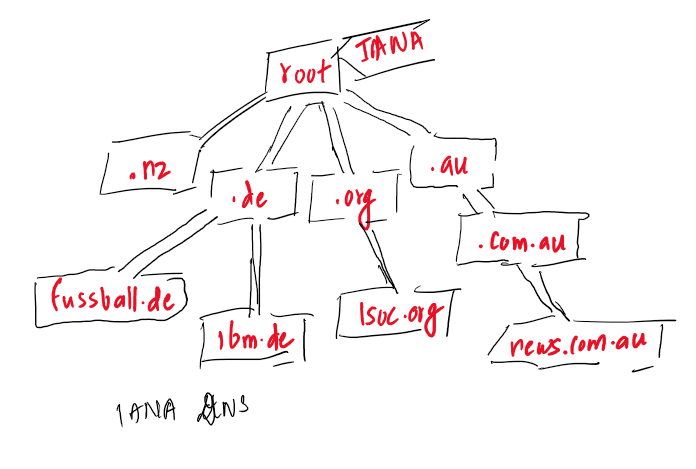
fig:DNS
One of the most important responsibilities of IANA involves the Domain Name System, often called DNS. DNS translates human readable website names into numerical IP addresses that computers understand. At the top of this system is the DNS root zone, which lists all top level domains used on the Internet. IANA maintains the official root zone database and coordinates updates to it. This includes common domains such as .com and .org as well as country code domains like .uk or .np. When a new top level domain is introduced, IANA records the technical details and ensures that it integrates correctly with the global DNS infrastructure. IANA also manages special purpose domains. The .int domain is reserved for international treaty based organizations. Another important one is .arpa, which supports technical functions such as reverse IP address mapping. These domains play a critical role in the internal operation of the Internet.
IANA manages the Domain Name System (DNS) root zone, which is the highest level of the global DNS hierarchy. It maintains the authoritative record of all top-level domains (TLDs), ensuring that each TLD operates correctly within the global system. This includes generic domains such as .com and country-code domains such as .uk.. IANA is responsible for assigning operators to top-level domains and maintaining their technical and administrative details. It ensures that each TLD registry follows established operational standards to maintain global consistency and reliability. In addition, IANA manages special-purpose domains. For example, the .int domain is reserved for international treaty-based organizations, while the .arpa domain is used internally by Internet protocols. The .arpa domain supports technical infrastructure functions such as reverse mapping of IP addresses and ENUM telephone number mapping. IANA also oversees Internationalized Domain Name (IDN) practices to support domain names in multiple languages and scripts.
2. Number Resources

fig: Structure
Another major responsibility involves global Internet number resources. These resources include IPv4 and IPv6 addresses. Every device connected to the Internet needs an IP address so other systems know where to send data. Instead of assigning addresses directly to users, IANA distributes large address blocks to Regional Internet Registries. These registries then allocate addresses to Internet service providers and organizations within their geographic regions. IANA also assigns Autonomous System Numbers, usually called ASNs. These numbers identify networks that participate in global Internet routing. Routers use ASNs to determine how data travels between networks. This structured allocation system keeps routing organized and prevents address conflicts across the Internet.
IANA coordinates the global allocation of Internet number resources. This includes Internet Protocol version 4 (IPv4) and Internet Protocol version 6 (IPv6) address spaces. Rather than assigning addresses directly to end users, IANA allocates large blocks of IP addresses to Regional Internet Registries (RIRs), which then distribute them to Internet service providers and organizations within their regions.. IANA also allocates blocks of Autonomous System Numbers (ASNs) to RIRs. ASNs are used to uniquely identify networks that participate in Internet routing. Through this hierarchical allocation system, IANA ensures the global coordination and uniqueness of Internet Protocol addressing systems, which is essential for proper routing and communication across the Internet.
f(Internet Numbers) = IPv4 + IPv6 + ASN
3. Protocol Assignments
Internet communication relies on many technical parameters, and IANA manages a large registry of these identifiers. One well known example is network port numbers. Every online service uses a specific port so computers know which application should receive incoming data. Port numbers range from 0 to 65535. Ports between 0 and 1023 are reserved for widely used services like web servers and email servers. Ports between 1024 and 49151 are registered for specific applications. Ports above 49152 are dynamic ports often used temporarily by client devices. IANA also maintains registries for many Internet protocol parameters, including HTTP status codes. These codes allow servers to tell browsers whether a request succeeded, failed, or was redirected somewhere else.
4. Language Attributes
Another area managed by IANA involves language identifiers used across the Internet. These identifiers help software understand which language a piece of digital content uses.
For example, the abbreviation “en” represents English. Web pages often include these codes so browsers, translation tools, and accessibility technologies can process content correctly. This small detail helps make the Internet easier to use for people around the world.
5. Private Enterprise Numbers
IANA also assigns Private Enterprise Numbers, usually called PENs. These numbers allow companies to define their own identifiers inside standardized network management systems.
Organizations use PEN values in technologies such as network monitoring tools and the Simple Network Management Protocol. By assigning a unique enterprise number to each organization, IANA ensures that private extensions do not conflict with identifiers used by other companies.
6. Media Types
Another registry maintained by IANA involves media types. Media types describe the format of data transmitted across the Internet so applications know how to interpret it.
For example, text files, images, videos, and application data each use different media types. A media type like video/h264 identifies a specific video encoding format commonly used in streaming services. Web browsers, APIs, and servers rely on these identifiers to correctly process incoming data.
7. Miscellaneous Internet Infrastructure Services
Beyond these responsibilities, IANA also maintains several supporting resources used by software systems and operating environments. One widely used resource is the time zone database.
The time zone database, often called tzdata, contains detailed information about time zones around the world, including daylight saving time rules. Operating systems, programming languages, and global applications depend on this database to display correct local times.
IANA also maintains public registries that allow network administrators and developers to look up technical identifiers used across Internet standards.
Summary
-
Language attributes are another area managed by IANA. These attributes use standardized abbreviations, such as “en” for English, to identify the language of content transmitted over the Internet.
-
Private Enterprise Numbers (PENs) are assigned by IANA to organizations. These numbers allow private companies to be uniquely identified in network management systems and protocols.
-
Media types are also registered by IANA. Media types specify the format of data transmitted across the Internet, such as text, image, audio, or video formats. For example, a media type like “video/h264” identifies a specific video encoding format used in streaming.
-
Also, IANA maintains the Time Zone Database (tz database), which contains detailed information about the world’s time zones and daylight saving rules. This database is widely used by operating systems and application programs to ensure accurate timekeeping and scheduling across different geographic regions.

fig: IANA WHOIS
Through these coordinated responsibilities, IANA ensures that essential technical identifiers of the Internet remain globally unique, standardized, and interoperable
Answer this when the questions are
Write down the roles and responsibilities of Internet Registries under IANA.
Discuss the role of IANA in regulation of the internet.