Internet Hierarchy and Resource Management
1. IANA and How It Supports RIRs
IANA sits at the very top of the Internet hierarchy. It doesn’t hand out IP addresses directly to users or ISPs. Instead, it allocates large blocks of IPv4 and IPv6 addresses, along with Autonomous System (AS) numbers, to Regional Internet Registries (RIRs). By doing this, IANA ensures that every RIR has globally unique resources to manage. This top-down approach keeps the Internet organized and prevents address conflicts. Essentially, IANA acts as the central coordinator, making sure that all networks worldwide follow the same rules and can communicate with each other reliably.

2. Regional Internet Registries (RIRs)
Regional Internet Registries, or RIRs, are at the top of the Internet number management hierarchy. They are nonprofit, membership-based organizations that coordinate the allocation and registration of Internet number resources within specific geographic regions. There are five RIRs globally: African Network Information Centre (AfriNIC), Asia Pacific Network Information Centre (APNIC), American Registry for Internet Numbers (ARIN), Latin America and Caribbean Network Information Centre (LACNIC), and Reseaux IP Europe Network Co-ordination Centre (RIPE NCC).
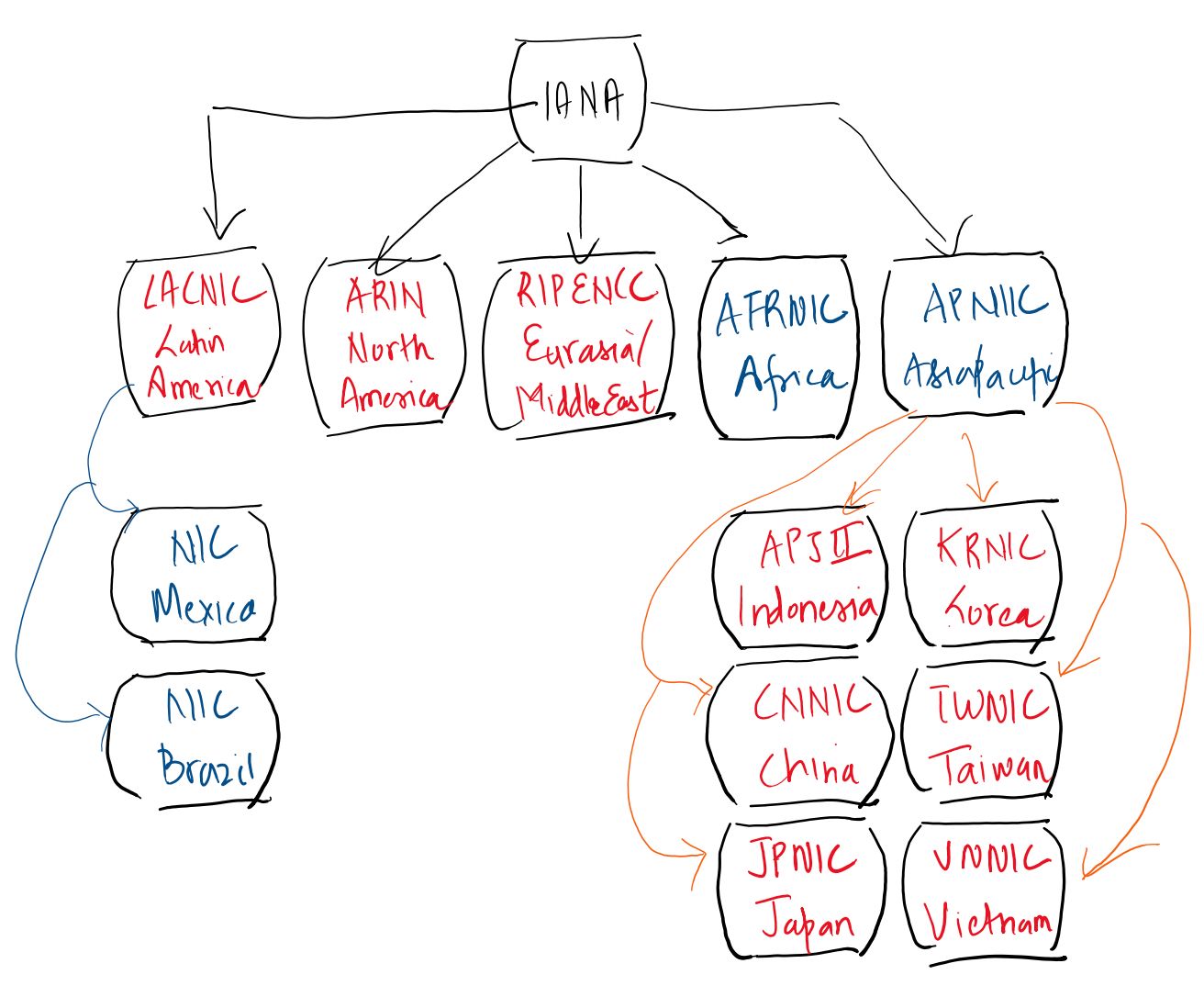
RIRs manage IPv4 and IPv6 address spaces as well as Autonomous System (AS) numbers. They allocate large blocks of IP addresses to National and Local Internet Registries within their regions. They also maintain important services like Whois directories, routing registries, and reverse DNS. Beyond registration, RIRs provide outreach, education, and training to help communities understand how Internet resources are distributed and managed. These organizations are 100% community-funded and open to participation, ensuring transparency and equitable access to Internet resources.
3. National Internet Registries (NIRs)
National Internet Registries operate under the umbrella of RIRs. Their focus is on managing Internet resources at the country or national level. NIRs are especially common in the Asia Pacific region, which falls under APNIC. Examples include APJII in Indonesia, CNNIC in China, JPNIC in Japan, KRNIC in Korea, SGNIC in Singapore, TWNIC in Taiwan, and VNNIC in Vietnam.

In the Latin America region, under LACNIC, national registries include NIC Argentina, NIC Bolivia, NIC Chile, NIC Mexico, and NIC Brazil. NIRs coordinate IP address allocation, maintain national databases, and ensure local policies follow global Internet standards. They act as a bridge between regional registries and local organizations, making Internet resource management more efficient and accessible. There are no NIRs currently operating in the RIPE NCC region, which relies directly on the RIR for resource allocation.
4. Local Internet Registries (LIRs)
Local Internet Registries are the next level in the hierarchy. An LIR receives a block of IP addresses from a regional RIR and distributes it to its customers. Most LIRs are Internet service providers, large enterprises, or universities. Membership in an RIR is required to operate as an LIR.
LIRs handle day-to-day resource management for their networks and clients. They assign IP addresses, maintain routing information, and ensure that their allocations comply with regional and global policies. By serving as the interface between RIRs and end users, LIRs make Internet connectivity scalable and organized.
5. Internet Service Providers (ISPs)
ISPs are the organizations that connect people, businesses, and institutions to the Internet. Access ISPs provide direct connections to individual users, often using fiber optics, copper lines, or wireless technologies. Hosting ISPs operate colocation centers, leasing server space and bandwidth to businesses or smaller ISPs. Transit ISPs carry high-capacity Internet traffic and link hosting ISPs with access providers.
ISPs rely on the hierarchy above them to receive IP addresses and maintain proper routing. Without ISPs, all the numbering and protocol coordination managed by RIRs, NIRs, and LIRs would never reach end users. Together, ISPs and Internet registries ensure that every device on the Internet can communicate globally in a reliable and organized way.
What are the roles of RIR, NIR and LIR?
Explain with internet hierarchy about how our country possible to access the internet?
With proper diagram, explain the hierarchy by which IANA manages the internet number resources to ensure global interoperability.
Explain the hierarchical structure for management of internet number resources?
How does the IANA help for internet management in this world? Explain with some example?