Gain and Attenuation
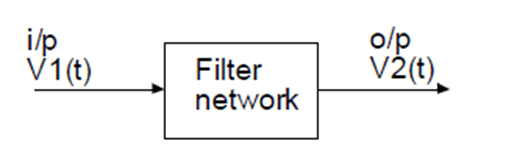
fig: Transfer Function interms of Voltage
The transfer function of the network is given by
Gain:
$ T(s) = \frac{V_2(s)}{V_1(s)} \quad \cdots \text{(a)} $
Gain is the measure of the ability of a circuit to increase the power or amplitude of a signal from the input to the output. In electronics amplifier amplifies the magnitude of the input signals, the amplifying ability of the amplifier is given in terms of output and input ratio. The technical term for the mean ratio of the signal output to the signal input of the same system is termed as Gain. It’s often expressed in log scale in DB (Decibel).
$
\text{i.e.,} \quad A_v = \frac{V_2(t)}{V_1(t)} \quad \Rightarrow \text{Voltage Gain}
$
$
A_i = \frac{I_2}{I_1} \quad \Rightarrow \text{Current Gain}
$
$
A_p = \frac{P_2(t)}{P_1(t)} \quad \Rightarrow \text{Linear Power Gain}
$
V1(t) having power P1 and o/p V2(t) having power P2.
In General, Power Gain is given by
$ \text{Power Gain (dB)} = 10 \log\left( \frac{P_{\text{out}}}{P_{\text{in}}} \right) = 10 \log\left( \frac{P_2}{P_1} \right) $ $ A_p = 10 \log\left( \frac{R \cdot V_2^2}{R \cdot V_1^2} \right) $ $ A_p = 10 \log\left( \frac{V_2^2}{V_1^2} \right) $ $ A_p = 10 \log\left( \left( \frac{V_2}{V_1} \right)^2 \right) $ $ A_p = 2 \cdot 10 \log\left( \frac{V_2}{V_1} \right) $ $ A_p = 20 \log\left( \frac{V_2}{V_1} \right) $
From Eq(1)
$ A_p = 20 \log \left( |T| \right) $ $ \frac{A_p}{20} = \log \left( |T| \right) $ $ |T| = 10^{\frac{A_p}{20}} $
Find the Gain for $|T| = 10^{10}$
$
\text{Gain} = 20 \log |T| = 20 \log |1010| = 200 \text{ dB}
$
Attenuation
Attenuation refers to reduction in signal strength commonly occurring while transmitting analog or digital signal over long distance. For unwanted range of frequency, the attenuation function of the filter becomes active and suppress such frequencies. It is measured in terms of decibel (db) and is given by
$ \alpha = \frac{1}{A_p} = \frac{P_{\text{in}}}{P_{\text{out}}} $ $ \alpha = -20 \log(|T|) $
For attenuation, the output must be less than input i.e., |T| < 0
$
|T| = \frac{1}{\left(10^{0.05}\right)^{\alpha}} = 10^{-0.05 \alpha}
$
Find the attenuation for $|T| = 10^{-10}$ (Negative Gain)
$
\text{Attenuation} = -20 \log |T| = 20 \log \left| 10^{-10} \right| = 200 \text{ dB (Positive)}
$