Half Power Point
It is the point where output power is one half of its input power.
$
\frac{P_2}{P_1} = \frac{1}{2}
$
$
A_p = 10 \log \left( \frac{P_2}{P_1} \right) = 10 \log \left( \frac{1}{2} \right) = -3.02\ \text{dB}
$

fig: Half power
Significance of Half power point:
- Roll off after half power point is very steep and for all intents it’s said to be cutoff point.
- 50% signal is loss due to attenuation. (Or where the voltage drops to about 70.7% of the original)
Is 3db and half power point same?
Let us consider:

fig: Transfer function interms of power
$
A_p = 10 \log \left( \frac{P_2}{P_1} \right) = 10 \log \left( \frac{1}{2} \right) = -3.02\ \text{dB}
$
$
A_p = 10 \log \left( \frac{P_2}{P_1} \right)
$
If:
$
\frac{P_2}{P_1} = \frac{1}{2}
$
then:
$
A_p = 10 \log \left( \frac{1}{2} \right) = 10 \log (0.5) = -3.01\ \text{dB}
$
Often rounded to:
$
A_p \approx -3\ \text{dB}
$
Also from voltage term explanation:
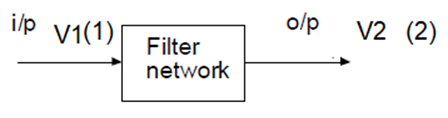
fig: Transfer function interms of voltage
$
10 \log \left( \frac{P_2}{P_1} \right) = 10 \log \left( \frac{R \cdot V_2^2}{R \cdot V_1^2} \right)
$
$
= 10 \log \left( \frac{V_2^2}{V_1^2} \right)
$
$
= 10 \log \left( \left( \frac{V_2}{V_1} \right)^2 \right)
$
$
= 2 \cdot 10 \log \left( \frac{V_2}{V_1} \right)
$
$
= 20 \log \left( \frac{V_2}{V_1} \right)
$
$
-3 = 20 \log \left( \frac{V_2}{V_1} \right) = 20 \log (V_2) \quad \text{(assuming } V_1 = 1\text{V)}
$
$
V_2 = \frac{1}{\sqrt{2}} \approx 0.707\ \text{V}
$
Output Voltage is 0.707 times input (in terms of voltage). Which shows that Yes, –3 dB corresponds to the half-power point.