Insertion Gain and Insertion Loss

fig: Gain and Attenuation Relation
One of the important factors that should be consider in design is that the minimum value of α should be zero degree. But this is not true in practical case since we are using active element, this need not be the case because the active element may provide the gain greater than one. It is necessary to reduce or increase the value of gain. Insertion gain is the amount by which a device increases the strength of a signal when inserted into the path. It’s also measured in decibels (dB). Amplifiers commonly provide insertion gain. Insertion gain is frequently provided by amplifiers.
Insertion Gain
When a filter (often an active filter) amplifies the signal rather than attenuates it, this is known as insertion gain. The output signal is stronger than the input in this instance. observed in filters that have active parts (such as op-amps) that increase the passband signal. For Filters with active element, the element provides gain so that the attenuation curve will be negative thus obtained curve is called insertion Gain. We call this unwanted Gain as insertion Gain.
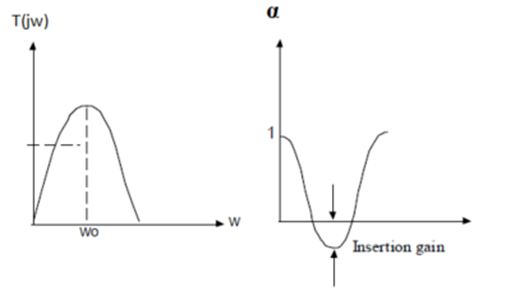
fig: Gain and Attenuation Relation for Insertion Gain
Example of Sunglasses:
- Picture specialized sunglasses that have tiny magnifying lenses integrated into them. This would make objects appear brighter or clearer even in low light. This is similar to insertion gain in that the gadget actually strengthens the signal that gets through.
- Consider night-vision-enhanced sunglasses that act as an active filter to strengthen the signal. During transmission, the signal is strengthened.
$
\text{Insertion Gain (dB)} = 20 \log_{10} \left( \frac{V_{\text{out}}}{V_{\text{in}}} \right)
$
Insertion Loss
In case of filters with passive elements, if the circuit provides excess attenuation, then the loss is insertion loss. Excess loss or attenuation must be overcome by additional compensation circuit such as amplifications. Insertion loss is the amount of signal reduction or weakening that occurs when a device (such as an amplifier, filter, or other component) is placed into a transmission path. The loss in power or signal strength is typically represented by a decibel (dB) value.
The drop in signal strength brought on by adding a filter to a circuit is known as "insertion loss." It measures the amount of the input signal attenuated (lost) at a specific frequency as a result of the filter. The signal is attenuated more when the insertion loss is higher. common in passbands, where the filter should ideally allow signals to flow through with little loss.

fig: Gain and Attenuation Relation for Insertion loss
Example of Sunglasses:
- Visualize yourself on a bright day outside. Strong signal: bright sunlight is shining on your eyes. The brightness that reaches your eyes is diminished when you wear sunglasses; this phenomenon is similar to insertion loss. Your eyes receive less light because of the sunglasses' reduction in light intensity.
- Similar to a passive filter that weakens signals, a passive sunglasses lens dims all light. A portion of the initial signal is absorbed or blocked.
$
\text{Insertion Loss (dB)} = -20 \log_{10} \left( \frac{V_{\text{out}}}{V_{\text{in}}} \right)
$
Summary
|
Term |
Meaning |
Example by Sun glasses |
|
Insertion Gain |
Signal power increases |
Sunglasses that brighten or amplify the view |
|
Insertion Loss |
Signal power decreases |
Regular sunglasses reducing sunlight intensity |