All Pass Filter (ALP)
It is a filter which passes all range of frequencies, i.e. PB 3 ranges from o to infinity. It is generally used when we needed design in case of Phase Equalization |H(w)| = 1 for all values of w
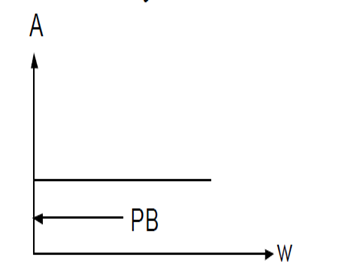
Fig: All Pass Response
Significance:
- All Pass filter have a flat frequency response, they neither emphasize or deemphasize any part of spectrum.
- They display signals in time as function of frequency.
- The time displacement accomplished by all pass filter is specified by its phase response.
- It is used in circuit to perform various frequency dependent alignment or time displacement. e.g.: In audio application includes filter bank, Reverberation, Phasor.
- delaying different frequencies by different amounts.
- All pass filter passes all the frequency components at constant gain. But it provides different phase shifts at different frequencies. Hence used as a phase corrector.
- It is used to compensate the phase changes of voice signals that may have occurred over telephone wires during transmission.
In case of achieving both phase linearity and good selective in the amplitude response, an all-pass filter is used in order to modify phase of the filter with desirable magnitude response, thereby not affecting its magnitude response.

fig: Delay Equalization
In case of additional delay, delay equalization or phase equalization consists of more or more all pass filler network.

fig: Magnitude and Phase relation of All Pass Filter
Answer if Q.N is Why do we need All pass Filter if it passes all the frequency provided to it? Explain with practical examples.