Delay Equalization
Bessel-Thompson response has the poorest magnitude response but due to linear phase response makes it suitable for pulse transmission compared to other responses, in case of delay equalization. Only the magnitude characteristics are not satisfactory. The solution is to introduce delays so that the total delay is nearly flat over the frequency band, i.e., constant delay. Such delay can be achieved by a delay equalizer.
To achieve both phase linearity \& good selectivity in amplitude, a general way is to use an all-pass filter. A delay equalizer consists of one or more all-pass networks with the same gain for all frequencies. Since the variation of delay should be fairly smooth, the addition of a first-order all-pass filter network, which is given by
\[
H(s) = \frac{s-b}{s+b}
\]
has a delay function equal to
\[
D(\omega) = \frac{2b}{b^2 + \omega^2}.
\]
The all-pass filter is given by curve 2, and the total delay-equalized value is curve 3, which is quite flat. In case of a wide range of curves, it is necessary to introduce several all-pass functions to equalize the delay.
The general result becomes in the form of a second-order system:
\[
H(s) = \frac{s^2 - (\omega_0/Q)s + \omega_0^2}{s^2 + (\omega_0/Q)s + \omega_0^2}.
\]
This procedure is known as **phase equalization**. It is very useful when the required filter poses high selectivity and, at the same time, a linear phase response or constant group delay. By adding a number of second-order all-pass filters with different \(Q\) and \(\omega_0\), it is possible to improve delay characteristics. Similarly, it would also be difficult to realize large functions.
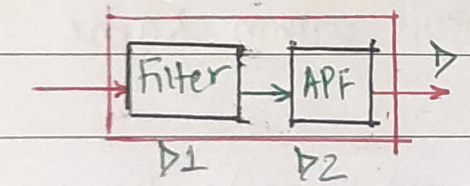
fig: Combined Delay
Summary, if delay characteristic is important then introduce additional delay so that the total delay responses becomes flat. Additional delay are obtained by using delay equalizer or using one or more linear phase all pass Network.
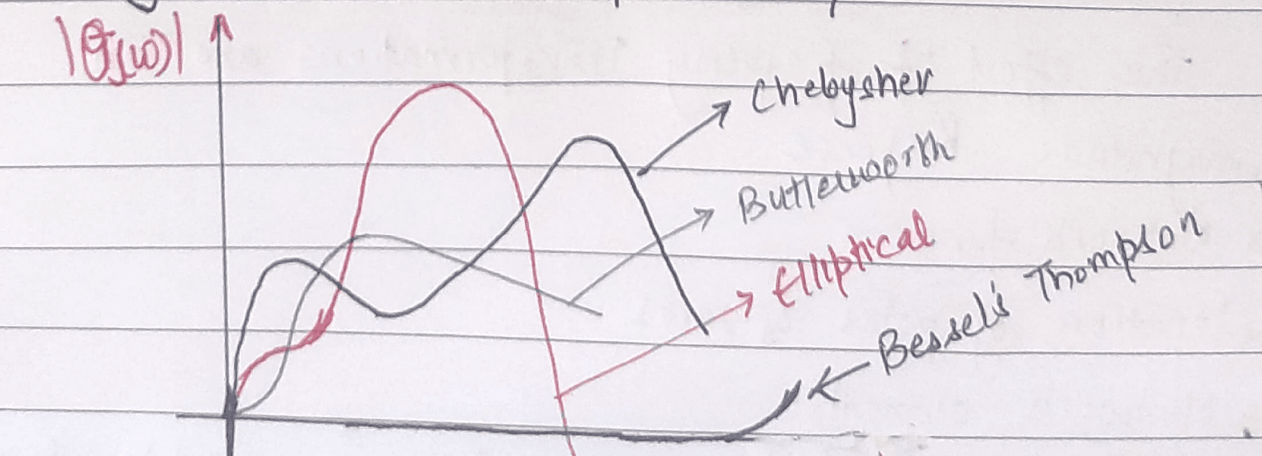
fig: Delay Response