Iterative Query vs Recursive Query in DNS
Iterative Query vs Recursive Query
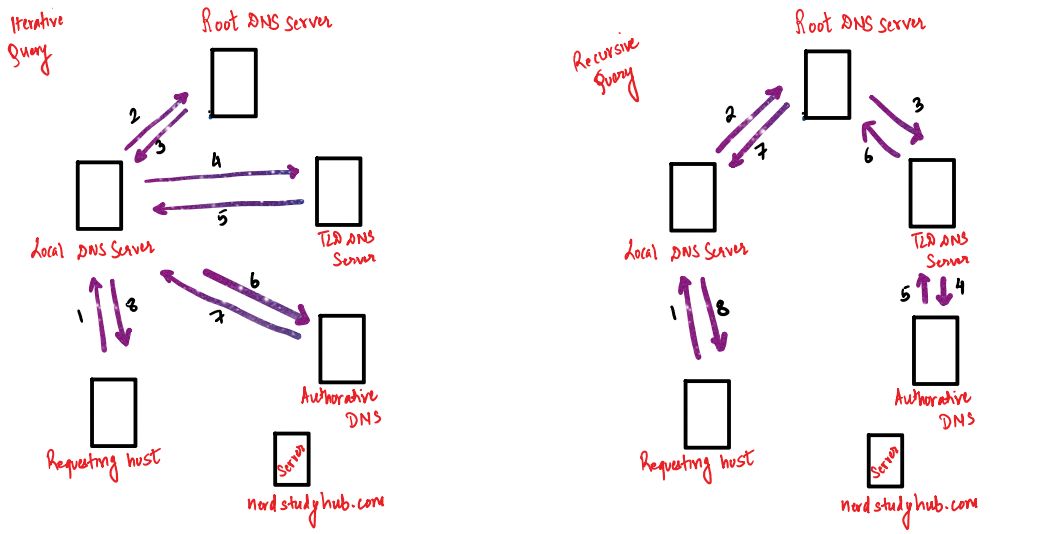
The difference between these two methods is mainly about responsibility during the lookup process.
- In iterative queries, the client communicates with multiple DNS servers until the answer is found.
- In recursive queries, the client sends one request and the DNS servers perform the rest of the lookup process until the correct response is returned.
- Both methods help DNS resolve domain names efficiently and ensure that users can access websites without needing to remember numeric IP addresses

When you type a domain like www.nerdstudyhub.com into your browser, your system needs to find its IP address. That process is called DNS resolution. Two main methods are used to complete this lookup: iterative query and recursive query.
Both methods reach the same result, but they handle the process differently. The key difference is who does the work, your system or the DNS server.
a. Iterative Query
In an iterative query, your system takes responsibility for finding the answer. It contacts DNS servers one by one until it reaches the correct server that knows the final IP address.
Here’s how it works step by step using www.nerdstudyhub.com.
Your computer sends a query to a DNS server, usually a local resolver. If that server does not have the answer, it replies with the address of a root server.
Your system then queries a root server. The root server does not know the exact IP, but it points to the .com TLD server.
Next, your system sends a request to the .com TLD server. This server responds with the authoritative name servers for nerdstudyhub.com, such as:
ns1.domaininnepal.com
ns2.domaininnepal.com
ns3.domaininnepal.com
ns4.domaininnepal.com
Now your system queries one of these authoritative servers. That server returns the actual IP address:
www.nerdstudyhub.com → 209.42.27.15
At each step, your system decides where to go next. That’s why it’s called iterative. You keep asking until you get the answer.
b. Recursive Query
In a recursive query, your system sends one request and expects a complete answer. The DNS server handles all the steps for you.
Here’s the same example using www.nerdstudyhub.com.
Your computer sends a request to a recursive resolver. This is usually provided by your ISP or configured in your system.
If the resolver does not have the answer cached, it starts the lookup process. It contacts a root server, then a TLD server, and finally the authoritative name server.
From the authoritative server, it gets the IP address:
www.nerdstudyhub.com → 209.42.27.15
The resolver then sends this final answer back to your computer.
From your side, it feels simple. You asked once, and you got the result. But behind the scenes, the resolver did all the work.
Key Difference Between Iterative and Recursive Query
In an iterative query, your system contacts multiple servers step by step until it finds the answer.
In a recursive query, your system sends one request, and the DNS server handles the entire lookup process.
Why Both Methods Matter
Both approaches are important. Recursive queries make things simple for users. You don’t need to worry about the lookup process.
Iterative queries are used between DNS servers themselves. They help distribute the workload and keep the system efficient.