Non Ideal Filters (Actual Filter)
Non-Ideal filter doesn’t pose gain of unity in the pass band and has some attenuation in Pass band with little gain or finite attenuation. A real filter is a practical device that selectively passes or attenuates frequency bands to change the frequency components of an input signal. Real filters differ from ideal filters in the sense that they have finite attenuation, gradual transitions, and practical limitations like stability and causality.
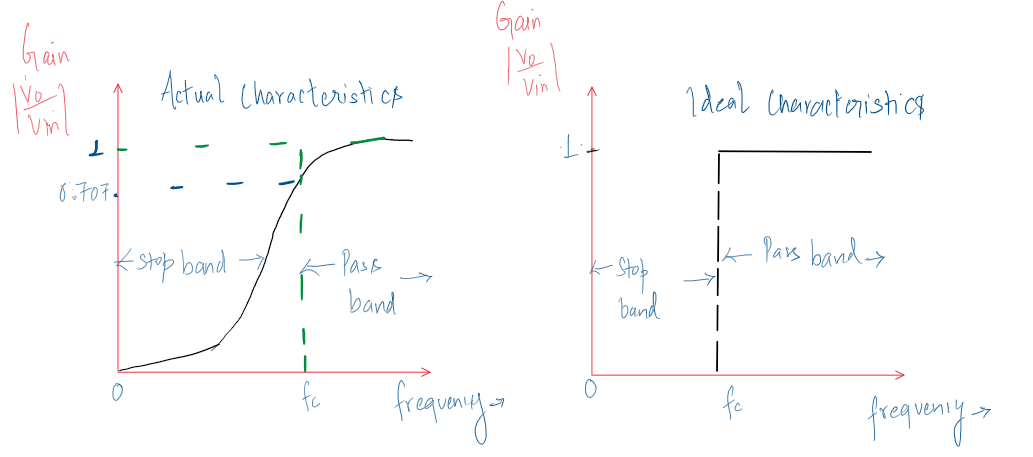
fig: Ideal and Non Ideal HPF Response
Importance:
-
Transition Band:
Definition: The frequency range where the filter response progressively shifts from high to low gain between the passband and stopband.
Expression: If the passband edge is represented by 𝜔𝑝 and the stopband edge by ω s, then
\[
\text{Transition Band} = [\omega_p, \ \omega_s]
\]
-
Pass Band Ripple
Definition: Minor variations in gain that occur within the passband. The response of the filter is not entirely flat.
Expression:
\[
1 - \delta_p \leq |H(\omega)| \leq 1 + \delta_p, \quad \omega \in \text{Passband}
\]
-
Stop Band Attenuation
Definition: The least amount of attenuation (reduction) of signals in the stopband.
Expression:
\[
|H(\omega)| \leq \delta_s, \quad \omega \in \text{Stopband}
\]
-
Phase Reponse and Group Delay
Defination: Signal distortion may result from the filter's introduction of frequency-dependent phase shifts.
Expression:
\[
\text{Phase response:} \quad \theta(\omega) = \arg(H(\omega))
\]
\[
\text{Group delay:} \quad \tau_g(\omega) = - \frac{d\theta(\omega)}{d\omega}
\]
-
Casuality and Stability
Definition:
- Causality: Only recent and historical inputs affect output.
- Stability: Bounded input results in bounded output.
Expression:
\[
\text{For a causal filter, the impulse response satisfies:} \quad h(t) = 0 \quad \text{for} \quad t < 0
\]
\[
\text{Stability requires all poles of } H(s) \text{ (Laplace domain) or } H(z) \text{ (Z-domain) to lie inside:}
\]
\[
\begin{cases}
\text{Left half-plane} & \text{for } H(s) \\
\text{Unit circle} & \text{for } H(z)
\end{cases}
\]
-
Finite Impulse Response
Definition: The impulse responses of real filters are frequently finite or nearly infinite in length.
Expression:
\[
y[n] = \sum_{k=0}^{M} h[k] \, x[n-k]
\]
Example: Butterworth Filter Magnitude Response:
\[
|H(\omega)| = \frac{1}{\sqrt{1 + \left(\frac{\omega}{\omega_c}\right)^{2N}}}
\]
\[
\text{where } N = \text{filter order}, \quad \omega_c = \text{cutoff frequency}
\]