Properties
\begin{align*}
\text{Behavior at } \omega = 0 \text{ rad/sec} \\
C_n(\omega) &= \cos^n(\cos^{-1}(\omega)) \\
C_n(0) &= \cos^n(\cos^{-1}(0)) \\
C_n(0) &= \cos^n\left(\frac{\pi}{2}\right) \\
C_n(0) &= \cos^n\left(n \frac{\pi}{2}\right)
\end{align*}
For \(n\) odd:
\[
C_n(0) = 0 \quad \text{rad/sec}
\]
And the transfer function is given by
\[
|T_n(j \omega)|^2 = \frac{1}{1 + \varepsilon^2 C_n^2(\omega)}
\]
\[
|T_n(j0)|^2 = \frac{1}{1 + \varepsilon^2 C_n^2(0)}
\]
\[
|T_n(0)|^2 = 1 \quad \text{(for odd } n \text{)}
\]
For \(n\) even:
\[
C_n(0) = \pm 1 \quad \text{rad/sec}
\]
\[
|T_n(j \omega)|^2 = \frac{1}{1 + \varepsilon^2 C_n^2(\omega)}
\]
\[
|T_n(j0)|^2 = \frac{1}{1 + \varepsilon^2 C_n^2(0)}
\]
\[
|T_n(j0)|^2 = \frac{1}{1 + \varepsilon^2 \cdot 1} = \frac{1}{\sqrt{1 + \varepsilon^2}}
\]
---
Behavior at \(\omega = 1\) rad/sec
\[
C_n(\omega) = \cos^n(\cos^{-1}(\omega))
\]
\[
C_n(1) = \cos^n(\cos^{-1}(1))
\]
\[
C_n(1) = \cos^n(0)
\]
\[
C_n(1) = 1 \quad \text{for all values of } n
\]
And the transfer function is given by
\[
|T_n(j \omega)|^2 = \frac{1}{1 + \varepsilon^2 C_n^2(\omega)}
\]
\[
|T_n(j1)|^2 = \frac{1}{1 + \varepsilon^2 C_n^2(1)}
\]
\[
|T_n(1)|^2 = \frac{1}{1 + \varepsilon^2 \cdot 1} = \frac{1}{\sqrt{1 + \varepsilon^2}} \quad \text{for all values of } n
\]
Beyond \(\omega > 1\), the value tends to decrease monotonically.
From the above relations:
fig: Proporties and Response
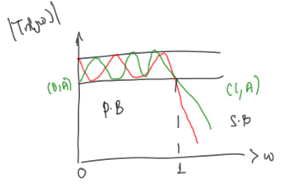
fig: Proporties and Response Combined